
· Solveion · Perspectives · 6 min read
We should thank the Chinese labs
Chinese open-weight models went from under two per cent of measured token consumption to more than half in eighteen months. The result is that no one has to buy their intelligence from two companies. That is worth being clear-eyed about, including the parts that complicate it.
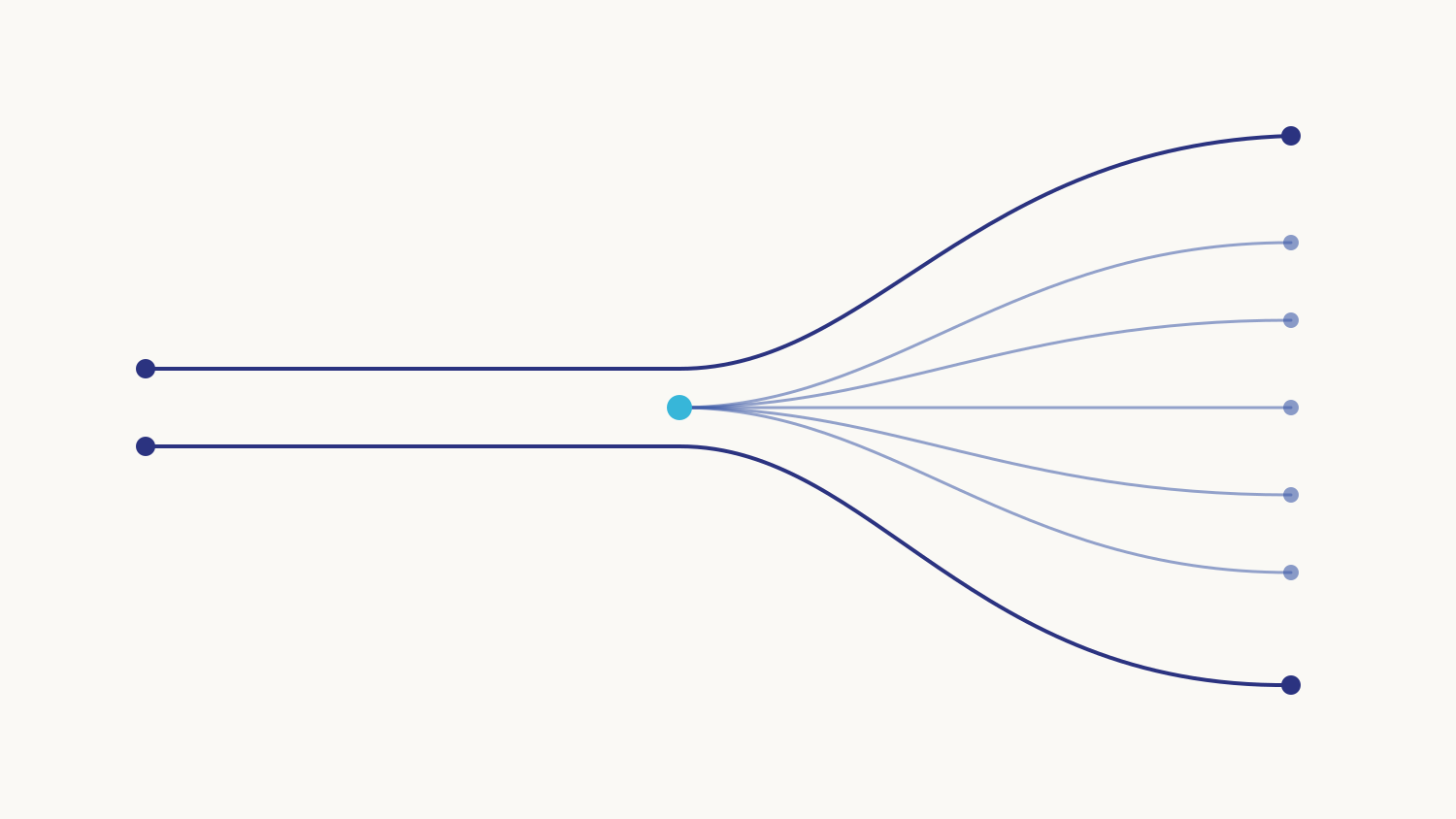
It is worth remembering what the market felt like before early 2025. Two or three Western labs held the frontier, priced accordingly, and spoke about their models the way a utility speaks about electricity, as something you would be connected to on their terms. Access was rationed by waitlist. Prices moved when the seller felt like moving them. If you wanted serious capability, there was no second door.
That world ended, and it was not ended by a regulator or by a Western competitor. It was ended by a series of Chinese labs deciding to publish their weights.
We think this deserves to be said plainly, because it tends to get discussed either as a security worry or as a geopolitical scoreline, and rarely as what it primarily is: the single most consequential piece of pro-consumer competition the AI market has seen.
The numbers are not marginal
The scale of the shift is easy to underestimate. On OpenRouter, which brokers model traffic across providers and publishes what actually gets consumed, Chinese-origin models went from under two per cent of token consumption in late 2024 to more than half by June 2026. Not a niche, not a price-sensitive tail. The majority of measured usage.
The capability gap that was supposed to make this impossible has largely closed. Moonshot released Kimi K3 in July at 2.8 trillion parameters, the largest open model ever published, and it sits at 57 on Artificial Analysis’s intelligence index, behind only a handful of variants from three closed frontier models. Z.ai’s GLM 5.2 leads the open-weight field and beats a recent OpenAI flagship on several long-horizon coding benchmarks at roughly a sixth of the price.
And the pricing is where the consumer benefit becomes unmistakable. DeepSeek cut V4-Pro to around $0.036 per million tokens for some usage. The comparable Western frontier models list around $5 per million input tokens. That is not a discount, it is two orders of magnitude, and it puts a floor under what anyone else can charge for competent inference.
The counterfactual is not hypothetical
Our reader’s instinct, that without this we would be dreaming about models like K3 rather than downloading them, is right, and there is a cleaner piece of evidence for it than most people cite.
In August 2025, OpenAI released gpt-oss-120b and gpt-oss-20b under an Apache 2.0 licence. Open weights, freely downloadable, from the lab that had spent years arguing that publishing frontier weights was irresponsible. It is difficult to read that as anything other than a competitive response, and it is the clearest available proof of the mechanism: the presence of a credible free alternative changed the behaviour of a firm that had no intention of changing it.
That is the whole argument in one event. Not that the Chinese models are better. Mostly they are not, quite. It is that their existence altered what the frontier labs had to do to keep customers.
Gratitude is the wrong word, and that is good news
Here we would push back gently on the framing, because the correction makes the conclusion more robust rather than less.
None of this was a gift. Publishing weights is what a rational firm does when it is behind on distribution and cannot win by selling access. You give away the layer your competitor charges for, and you compete where you are stronger. It is a well-worn strategy and it is being executed extremely well.
This matters because it tells you how durable the benefit is. Charity ends when the donor’s mood changes. Interest persists as long as the underlying position does, and every one of these labs still has the same incentive to erode the value of proprietary model access. You can plan around interest. You cannot plan around goodwill.
The parts that complicate it
A post that only cheered would not be much use, so three things belong on the record.
Open weights are not open source. You get the artifact, not the recipe. Training data, training code and most methodology stay private. This is still enormously valuable, since you can run it, inspect it, fine-tune it, and nobody can take it away, but it is not the same as software you could rebuild from scratch, and the word “open” is doing heavy lifting.
The ecosystem may be more entangled than the competition story suggests. In April, OpenAI, Anthropic and Google jointly said through the Frontier Model Forum that they would share intelligence to block what they call adversarial distillation, naming DeepSeek, Moonshot and MiniMax; Anthropic alleged some 24,000 fraudulent accounts used to harvest around 16 million exchanges. These are allegations, not findings, and we would not treat them as settled. But if they are substantially true, the open models are in part a derivative of the closed frontier, and the two ecosystems are less independent than a clean David-and-Goliath reading implies.
Some of these models carry content restrictions that reflect where they were built, particularly on politically sensitive topics. For most commercial workloads this is irrelevant. For a few it is not, and anyone arguing that these models serve the user ought to say so rather than leave it for the reader to discover.
Why this is worth caring about even if you never run one
The practical value of a credible alternative is not that you use it. It is that you could.
We have written before that the peripheral products are where the frontier labs’ real switching costs live, and that today’s subsidised pricing is effectively a loan against tomorrow’s rates. Both of those observations get considerably less alarming when there is a competent free option one abstraction layer away. Your negotiating position with a vendor is not determined by what you are using. It is determined by what you could switch to in a quarter, and how credibly you can say so.
That is the thing worth protecting. Not any particular model, most of which will be obsolete within the year, but the condition in which no small group of companies gets to set the price of machine intelligence by itself. For eighteen months that condition has held, and it has held because a handful of labs, mostly in China and mostly out of self-interest rather than generosity, decided that the weights should be public.
Whatever else one thinks about it, that has been good for everybody who buys rather than sells.